
The 19 Best B2B Intent Data Providers in 2026, Ranked by the Signal They Own
Somebody on the exec team reads that intent data shortens sales cycles, and a line item appears. Nine months on, the picture is usually the same one. Three contracts. Two of them quietly resell the same feed. A Slack channel nobody reads, because the first forty alerts were companies that were never going to answer the phone, and reps only need to be burned twice before they stop opening the door.
We get called in at about that point, and the conversation almost never turns out to be about the vendor. It is about a category error that the whole market has an interest in maintaining. A named human sitting on your pricing page for four minutes, and an anonymised uptick in article reads somewhere across a publisher network, are both sold to you as intent. One of them you can call before lunch. The other is a hint about a company, resolved by IP address, flattened to a domain, and already a week old when it lands in your CRM. Same word. Priced within range of each other. Nothing else in common.
So this list runs the other way round from the rest of this search result. The signals come first, eight of them, ordered by how much each one actually proves. The providers sit underneath whichever signal they genuinely own. Each one carries what it proves, whether you get a person or a domain, how quickly it rots, and the particular way it will lie to you, because every one of them lies in a specific and predictable way. Read only the first section and you will still leave able to name the signal your pipeline is missing. That is the part no vendor comparison is incentivised to tell you.
Quick Digest
- Intent is eight signals wearing one label. Your own site, review marketplaces, champion job changes, topic surge, keyword and bidstream, opt-in publisher research, hiring and funding, and install-base renewal timing. Different evidence, different shelf life, different correct response.
- Three of the eight are worth acting on today. Five are not. Give a rep an account-level topic surge and ask for a cold call and you have built a machine for wasting their morning. That single mismatch is most of what people mean when they say intent data does not work.
- Ask every vendor whose data model produces their third-party intent. One publisher co-op sits underneath a large share of the products in this category. Two contracts against it buys you one signal and two invoices.
- Bidstream provenance is a live regulatory question. The UK ICO and the Belgian data protection authority have both found that its collection and use conflicts with GDPR. If a vendor sells you keyword intent, the proportion that comes from bidstream belongs in the contract, not in the demo.
- ZoomInfo Streaming Intent is bidstream-derived. It arrived with the 2020 Clickagy acquisition. That is not a reason to avoid it. It is a reason to ask the question above.
- Person-level identification is mostly an American privilege. RB2B resolves people for US traffic only. Dealfront is company-level in GDPR regions by design. Half the visitor-ID demos a European buyer sits through are of a feature they will not receive.
- Informa TechTarget sells named, consented people rather than accounts. That makes it a different class of evidence from everything else here, and it works only if you sell into enterprise IT. Outside that, there is nothing in it for you.
- The best signal available to you is almost certainly free and uninstrumented. Your pricing page, your churned champions, your comparison pages. We have yet to meet a team that had exhausted those before signing a third-party contract.
Intent is eight signals wearing one label
Intent data is any observable behaviour suggesting a company is moving toward a purchase. That is accurate, and it is nearly useless for buying anything, because it covers a person typing your product name into a comparison page and it covers a statistical inference drawn from ad-exchange traffic. Both get sold as intent. Only one of them is evidence.
The usual way to sort this is by where the data came from: first-party, second-party, third-party. You will find that sidebar on every page ranking for this term. It describes the supply chain and tells you nothing about the signal. Two third-party feeds can differ from each other more than either differs from your own web analytics. Sorting by provenance is how a shortlist ends up holding three products that do the same job.
Sort by what the signal proves and the category comes apart cleanly into eight families. This is the split we reach for when a team asks us why an intent programme that looks healthy on a dashboard is producing no meetings. They are ordered here by how much each one proves, which is emphatically not the order of what they cost.
| # | Signal | What it proves | Resolution | Half-life | How it lies to you |
|---|---|---|---|---|---|
| 1 | First-party visit | Someone at this account is on your page, now | Person in the US, account elsewhere | Hours | Competitors, candidates, your own agency, bots |
| 2 | Category evaluation | Someone is weighing you against a named rival, late | Account, sometimes person | Days | Analysts, consultants and students research too |
| 3 | Relationship | Someone who already chose you once has new budget | Person | Weeks, inside a quarter | A lateral move carries no budget authority |
| 4 | Topic surge | This account is reading above its own baseline | Account, often domain | One to three weeks | Big companies surge on everything |
| 5 | Keyword and bidstream | Devices at this address matched your terms | Account, inferred by IP | Days | Shared IPs, VPNs, home broadband, exchange noise |
| 6 | Opt-in research | A named, consented person read buy-cycle content | Person | Weeks | The person is real. Their authority is not guaranteed |
| 7 | Initiative | This account just funded the project you sell into | Account | Months | Backfills and evergreen posts read as growth |
| 8 | Install base and renewal | They run your rival and the window is opening | Account | Quarters | The tag outlives the tool it detected |
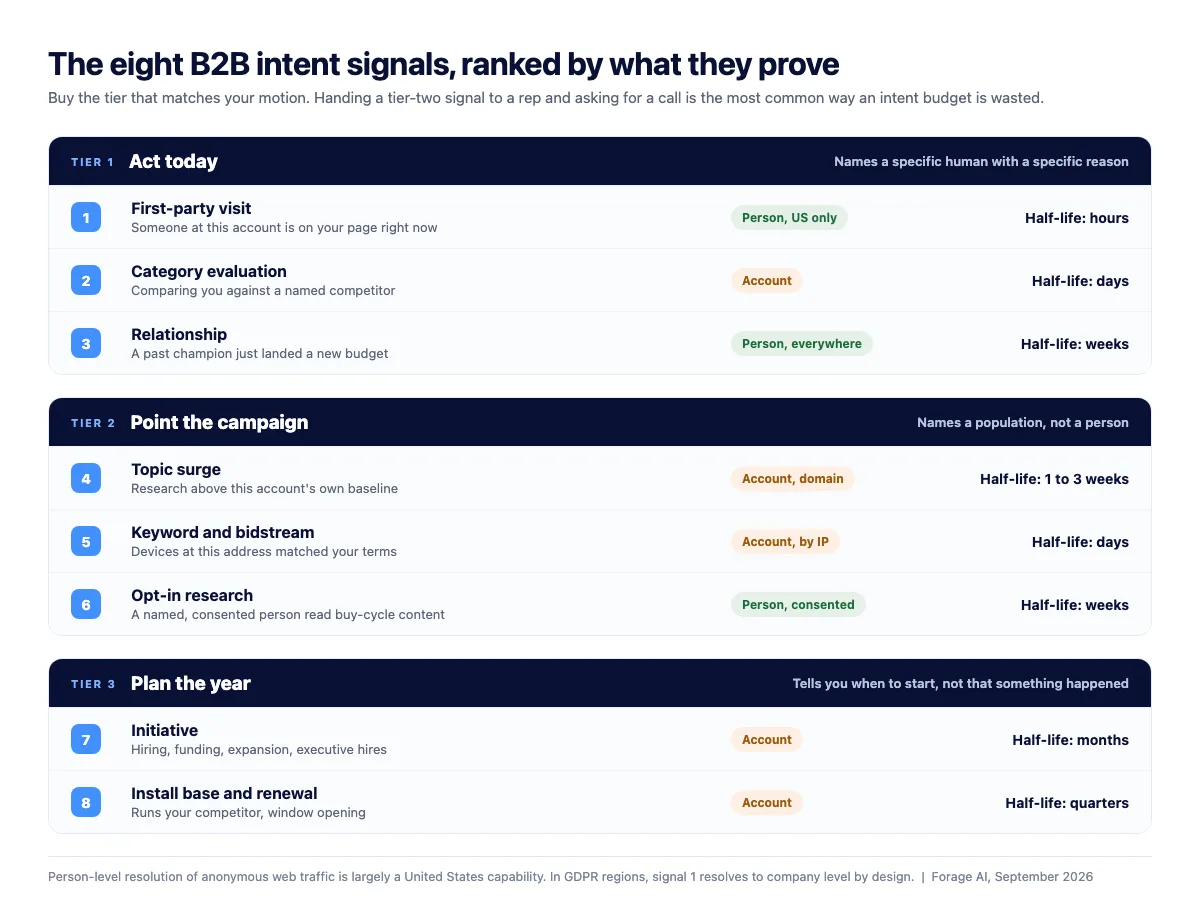
The three tiers matter more than the eight rows. Signals one to three put a specific human in front of a rep with a specific reason to talk, today. Four to six describe a population, which is a marketer's input and not a caller's. Seven and eight tell an account team which logos to build a plan around this year. Buy from the wrong tier for your motion and the product will work exactly as sold while producing nothing, which is the most expensive kind of failure because nobody can point at what broke.
One more distinction worth settling before you shop, because vendors have no reason to settle it for you. Firmographics describe what an account is. Intent describes what it is doing, and it expires. Headcount and revenue band are stable facts you license once and refresh on a schedule. A pricing-page visit is worth something for a few hours. The two arrive on one invoice more often than not, and a firmographic contract renews far more predictably than an intent one, so nobody selling both is in a hurry to separate them for you. The sourcing side of that first category is in our guide to firmographic data sourcing.
Quick Summary
What are the main types of B2B intent data?
Eight behave differently enough to buy separately: first-party visits to your own site, category-evaluation signals from review marketplaces, relationship signals from champion job changes, topic surge from publisher co-ops, keyword and bidstream intent inferred from IP-level activity, opt-in research from consented publisher networks, initiative signals from hiring and funding, and install-base intent from technographic and contract-timing data. The familiar first, second and third-party split describes where each was collected rather than what it proves, which is why it makes such a poor basis for a shortlist.
Expert Insights
Resolution is a geography question before it is a product question, and it decides your whole motion. Person-level identification of anonymous web traffic is substantially a United States capability. Vendors built for GDPR regions resolve to company level by design, and Dealfront says so plainly rather than burying it. A European buyer watching a US visitor-ID demo is being shown a feature they will not be sold. Better to have that conversation in the first call than to discover it in onboarding.
How we ranked them, and what we could not check
No vendor paid for placement, and none was contacted before this published. The nineteen below recur across the search results for this term and were independently purchasable in September 2026. They are grouped by the signal they own rather than ranked against each other, because ranking a website pixel against a publisher co-op would require pretending they compete.
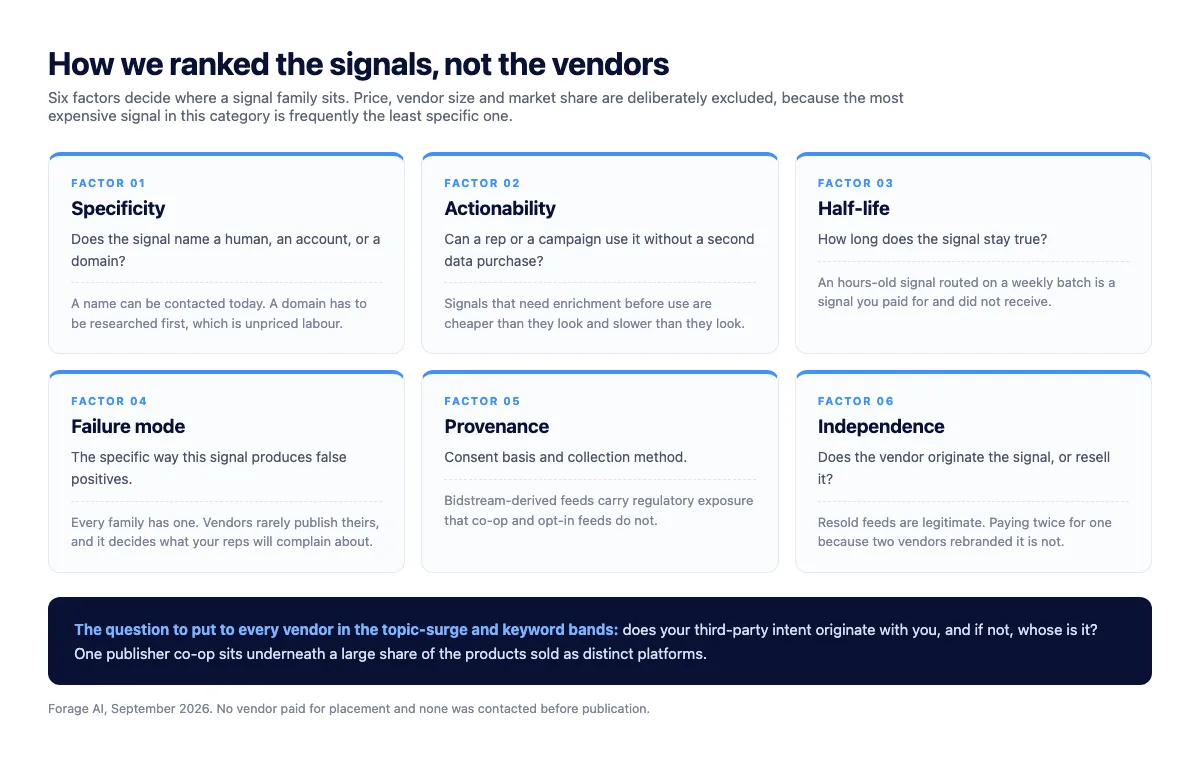
The signal order is the argument, so it is worth being explicit about how it was built. Two axes, and nothing else: how much the signal proves about a specific buyer, and how directly a team can act on it without buying something else first. Price, vendor size and market share are deliberately excluded. In this category they correlate weakly with specificity and sometimes invert it.
| Factor | The question | Why it moves the ranking |
|---|---|---|
| Specificity | A human, an account, or a domain? | A name gets contacted today. A domain gets researched first, and nobody prices that labour. |
| Actionability | Usable without a second purchase? | Signals needing enrichment before use are cheaper and slower than they look, in that order. |
| Half-life | How long does it stay true? | An hours-old signal on a weekly batch is a signal you bought and did not receive. |
| Failure mode | How does it produce false positives? | Every family has one. Vendors rarely publish theirs. It decides what your reps complain about. |
| Provenance | Consent basis and collection method? | Bidstream-derived feeds carry exposure that co-op and opt-in feeds do not. |
| Independence | Originated or resold? | Reselling is legitimate. Paying twice because two vendors rebranded one feed is not. |
Every rating below is printed with its sample size and the month we read it. A star rating without a denominator is decoration. The distance between 106 reviews and 12,882 is the distance between an anecdote and a measurement, which is why a 4.7 and a 4.4 on this page are frequently not comparable in the direction you would assume. Where a figure is seller-level, meaning it aggregates every product a vendor sells under one profile, we say so. A seller-level score for a company with six products is not a score for the one you are buying.
What we could not verify, said plainly. Review platforms return errors to automated access, so nine providers here carry no usable rating with a sample size as of September 2026: G2 Buyer Intent, TrustRadius, Intentsify, Informa TechTarget, PredictLeads, HG Insights, SalesIntel, Coresignal and Forage AI. We print the absence rather than borrowing a number from an adjacent listing. Pricing is much the same. Almost nothing in this category is published, so we describe how each vendor charges and give a figure only where a named third party supports it.
Quick Summary
How should I read the provider entries on this page?
Read each band's signal card before the vendors inside it. The band describes what that class of evidence can and cannot prove, and that stays true when a vendor is acquired, repriced or renamed. Inside an entry, weight resolution and the watch-out above the rating, and treat any score built on fewer than a few hundred reviews as an early indication rather than a verdict.
Expert Insights
Provenance is the thing that has moved most since 2024, and it has moved from engineering into procurement. The UK Information Commissioner and the Belgian data protection authority have both found that collecting and using bidstream data conflicts with GDPR, and privacy researchers have argued for years that real-time bidding cannot be reconciled with consent as the regulation defines it. None of that makes keyword intent unusable. It does mean the question belongs in the contract rather than the technical appendix, and we have watched it go unasked in procurement cycles that were otherwise rigorous.
The 19 intent data providers at a glance
Find the signal you are missing in the middle column and read that band. The numbers are positions in a taxonomy, not a league table.
| # | Provider | Signal it owns | Resolution | Best for |
|---|---|---|---|---|
| 1 | Forage AI | Custom-sourced | Whatever the source supports | A signal that predicts your deals and exists in no vendor taxonomy |
| 2 | Coresignal | Custom-sourced, raw | Company and employee records | Engineering teams building their own signal layer |
| 3 | RB2B | 1. First-party visit | Person, US only | US-heavy traffic, names, no enterprise contract |
| 4 | Warmly | 1. First-party visit | Person, US-strong | Mid-market teams who want the follow-up in the same tool |
| 5 | Dealfront | 1. First-party visit | Company in GDPR regions | European traffic, and a privacy review you have to survive |
| 6 | G2 Buyer Intent | 2. Category evaluation | Account | Vendors with a real G2 presence selling to SMB and mid-market |
| 7 | TrustRadius | 2. Category evaluation | Account | Enterprise-skewed categories and long buying groups |
| 8 | UserGems | 3. Relationship | Person | Long CRM history, high ACV, land-and-expand |
| 9 | Common Room | 3. Relationship and community | Person | Developer tools, open source, product-led motions |
| 10 | Bombora | 4. Topic surge | Account, domain | The reference co-op, bought direct and modelled yourself |
| 11 | Cognism | 4. Topic surge, packaged | Account plus contact | European teams who need a mobile number attached |
| 12 | SalesIntel | 4. Topic surge, packaged | Account plus contact | Teams who value human verification over raw volume |
| 13 | ZoomInfo | 5. Keyword and bidstream | Account | Existing customers who want intent in the seat they own |
| 14 | 6sense | 5. Keyword, predictive | Account | Mature ABM teams who will act on a stage prediction |
| 15 | Demandbase | 5. Keyword and co-op | Account | Teams who need to show the evidence behind a score |
| 16 | Intentsify | 5. Keyword, multi-source | Account and buying group | Buyers who want signal and activation on one contract |
| 17 | Informa TechTarget | 6. Opt-in research | Person, consented | Enterprise IT vendors. Nobody else |
| 18 | PredictLeads | 7. Initiative | Account | Teams who will build scoring against an API |
| 19 | HG Insights | 8. Install base and renewal | Account | Displacement timed to contract windows |
The 19 best B2B intent data providers, by the signal they own
Each band opens with a card describing the signal. Read it before the vendors underneath. The card is the part that survives an acquisition, a rename or a repricing, and it is why two providers in one band are genuine alternatives while two in different bands are not, whatever the sales decks imply.
Band A. When the signal that predicts your deals is in nobody’s taxonomy
Check the other eight bands first. For most teams one of them covers the job, and a subscription beats a build on both cost and speed. But some businesses are predicted by something no co-op has ever had a reason to track. A licence appearing on a state register. A tender posted to a procurement portal that no aggregator indexes. An accreditation granted to a facility. A clause changing in a published policy document. Those are real buying signals, they are public, and they are absent from every taxonomy because no advertising network makes money instrumenting them.
1. Forage AI
| Attribute | Detail |
|---|---|
| Signal it owns | Custom-sourced. Signals extracted and maintained from public sources no off-the-shelf feed carries, defined against your pipeline rather than a fixed topic list. |
| Resolution | Whatever the source supports, usually the entity the source is about: a filing, a licence holder, a facility, a posting. |
| Best for | Teams who can name the event that precedes a deal, can point at where it is published, and have not found it in anything they trialled. |
| Pricing | Scoped engagement rather than a per-seat subscription. Not published. |
| User reviews | No independently verified rating with a usable sample size, September 2026. |
| Watch-out | Not for a team that needs alerts running this afternoon. Sign-off to first dataset is 1-2 weeks. And if a co-op, a review marketplace or a visitor pixel already sees your signal, buy that instead. |
The case for building is narrower than we would like it to be, and it is worth saying so before saying anything else. If your buyers research your category on B2B publisher sites, a co-op already watches them. If they compare vendors on review marketplaces, G2 or TrustRadius already watches them. Custom sourcing earns its place only when the event that predicts your revenue happens somewhere no ad network and no publisher co-op has a commercial reason to instrument.
That turns out to be a real set of places. Regulatory registers, procurement portals, accreditation bodies, permit filings, niche trade forums, and the customer's own website changing in a way that means a project just started. Forage AI runs this as a managed service rather than a tool. Sourcing, schema, extraction and maintenance sit on our side, and the output lands as a scheduled feed, an API, or a direct load into your warehouse.
Maintenance is the part that decides whether any of this survives contact with a quarter. A custom signal is not a one-off scrape. Sources restructure, add anti-bot measures, change schemas, and a pipeline nobody owns degrades in silence until somebody notices the alerts stopped three weeks ago. Forage AI absorbs selector drift, anti-bot evolution and schema changes as part of the service, and every delivery clears a 3x QA team before it reaches your system. The starting base is 500M+ websites, 10M+ documents and 5M+ professionals, with SOC 2 compliance and on-premise or private-cloud deployment where the data cannot leave your environment.
2. Coresignal
| Attribute | Detail |
|---|---|
| Signal it owns | Raw material rather than a finished signal. Company, employee and job-posting datasets on a refresh schedule, by API or bulk file. |
| Resolution | Company and employee records. Entity resolution and scoring are yours. |
| Best for | Data teams who have decided to build their own intent layer and want a supply to build it on. |
| Pricing | Credit-based on search and collect volume. Published tiers exist; enterprise volume is negotiated. |
| User reviews | No independently verified rating with a usable sample size in this category, September 2026. |
| Watch-out | Not an intent product, and it does not claim to be. No scoring, no surge model, no alerting. Without an engineer who owns it, a Coresignal contract produces storage costs and nothing else. |
It belongs in this band because of what teams actually do with it. The recurring story: a data team looks hard at the co-op feeds, concludes that domain-level surge does not predict their deals, and decides to model hiring velocity, headcount change and role composition instead. Coresignal supplies the underlying records at a cadence no manual process matches.
The trade is explicit and it is usually mispriced in the business case. You gain control and a lower marginal cost per signal. You take on modelling, entity resolution and maintenance. Teams who do well with it have a named owner and a hypothesis before they sign. Teams who bought it because it looked cheaper than 6sense generally discover that the modelling they left out of the comparison was the expensive half.
Band B. Signal 1, first-party visit intent
Signal 1 · First-party visit intent
Proves. Someone at this account is on a page you chose to instrument, right now
Resolution. Person for US traffic. Company only in GDPR regions, by design and by law
Half-life. Hours. A pricing-page visit on a Monday digest is a signal you bought and threw away
How it lies to you. Your competitors read your pricing page. So do candidates, analysts, your own agency and a great many bots. Reported identification rates run somewhere between 15% and 45% by plan and traffic mix, so most visitors stay invisible whatever the demo showed
The correct play. Route to a human in minutes, and only from pages that carry commercial meaning. Pricing, comparison, integrations. Never the blog
This is the strongest signal money can buy, and it is the one most teams underinstrument before spending on anything else. It is your own property, the consent basis is the cleanest in the category, and the visitor is demonstrably interested in you rather than in your category. The limit is structural: it only fires for people who already found you, which is why it cannot be the whole programme.
3. RB2B
| Attribute | Detail |
|---|---|
| Signal it owns | First-party visit intent, person-level, in Slack within minutes. |
| Resolution | Person for US traffic only. International visitors resolve to company or not at all. |
| Best for | US-heavy B2B traffic. Names without an enterprise commitment. |
| Pricing | Monthly on identification credits. The January 2026 change removed contact-level data from the free tier. |
| User reviews | 4.5/5 from 283 G2 reviews, accessed September 2026. |
| Watch-out | Match rate is the entire product and the reported figures disagree, roughly 15% to 45% depending on plan and source. US-only person resolution makes it close to useless on European traffic. |
RB2B did more than anyone to make person-level visitor identification a default expectation, mostly by giving away a usable version and letting the Slack alert sell itself. The product is deliberately narrow. It tells you who visited, it pushes that to Slack, and it stops. For a team that wants the signal without inheriting a platform, that narrowness is the whole appeal.
Two things belong in the business case. The match rate is genuinely variable and the published ranges do not agree with each other, some sources putting it at 15% to 45% by plan and others at 20% to 40%. Either way the majority of your traffic will not resolve, and a demo run against a friendly test visit will never show you that. The second is that the free tier changed in January 2026, so any plan built on the old economics needs rechecking before it goes to finance.
4. Warmly
| Attribute | Detail |
|---|---|
| Signal it owns | First-party visit intent, bundled with routing, chat and orchestration. |
| Resolution | Person, US-strong. Company level elsewhere. |
| Best for | Mid-market B2B teams who want identification and the follow-up action in one place. |
| Pricing | Modular, priced on output rather than seats. The free tier went in 2026. |
| User reviews | 4.6/5 from 203 G2 reviews, accessed September 2026. |
| Watch-out | The modules accumulate. The identification price in the first call is rarely the price of the configuration you end up running. |
Warmly is for teams who have worked out that the alert was never the hard part. Knowing a VP of Engineering at a target account read your integrations page is worth precisely nothing if it lands in a channel with no owner. Warmly bundles identification with the routing, the chat prompt and the sequence trigger, which is the work most teams underestimate when they buy a cheaper point tool and then spend a quarter wiring it to something.
The rating is good on a young corpus, and what complaints there are cluster on cost composition rather than accuracy, which is the more forgivable of the two. If you already run a routing layer you like, you are buying it twice. If you do not, this is a cheaper path to a working motion than assembling three tools and an owner.
5. Dealfront
| Attribute | Detail |
|---|---|
| Signal it owns | First-party visit intent under a GDPR-first posture, plus European company data. |
| Resolution | Company level only in GDPR regions. No person-level identification there. |
| Best for | European traffic, and teams whose legal function has already said no to person-level identification. |
| Pricing | Modular subscription. |
| User reviews | 4.5/5 from 112 G2 reviews, accessed September 2026. The small corpus reflects the Leadfeeder and Echobot merger. |
| Watch-out | US coverage is thin next to the US-native tools, and the review evidence is split across the pre-merger products, so the sentiment behind that number is harder to read than it looks. |
Dealfront answers a legal question as much as a data one. Person-level de-anonymisation of web visitors sits badly with GDPR, and Dealfront resolves that by not offering it in those regions. For a European company, or an American one with meaningful European traffic, that is a feature that survives a privacy review rather than a limitation you argue about.
What you give up is precision. Company-level identification says Acme is interested and leaves the buying group to you, which is a slower motion and a defensible one. Worth knowing: Leadfeeder is not a product you can buy any more. Several comparison pages still list it separately, and a shortlist holding both Leadfeeder and Dealfront is holding one company twice.
Band C. Signal 2, category-evaluation intent
Signal 2 · Category-evaluation intent
Proves. Someone is comparing products in your category, often on a page that names you and a rival together
Resolution. Account, occasionally person depending on platform and plan
Half-life. Days. Comparison behaviour clusters hard around a decision, then stops
How it lies to you. Analysts, consultants, students and competitors browse review sites constantly. Some platforms also fold general site traffic into the signal, which dilutes it with readers who were never buyers
The correct play. Treat a competitor-comparison view as a late-stage alert. Route it to the account owner the same day, with the rival named in the brief
This is the highest-conviction third-party signal in B2B, and the volume is small on purpose. Someone reading your alternatives page has a shortlist. The trade against topic surge is exact: far fewer signals, each worth vastly more, each arriving late enough that you are already in a competitive deal you may not have known was running.
6. G2 Buyer Intent
| Attribute | Detail |
|---|---|
| Signal it owns | Category-evaluation intent from profile views, category browsing, comparison and alternatives pages. |
| Resolution | Account, with company name, location and the timestamp of the visit. |
| Best for | Vendors with a genuine G2 presence selling into SMB and mid-market. |
| Pricing | An add-on to a G2 Brand Package, not a standalone purchase. Not published. One buyer report cites roughly $10,000 a year for Core, which we could not independently confirm. |
| User reviews | No independently verified rating with a usable sample size, September 2026. |
| Watch-out | You cannot buy the signal without buying the presence. The audience also skews SMB and mid-market, so enterprise-only sellers see thinner volume than the headline traffic suggests. |
The structural fact about G2 is that the intent is a by-product of a marketing spend rather than a data purchase. Useful signal requires a profile people visit, which requires reviews, which requires a review programme with an owner. Vendors who treat Buyer Intent as a line item and skip the presence work get a nearly empty feed and conclude the product is weak. The product is fine. The input was missing.
There is a competing critique in circulation, which comes largely from TrustRadius and should be read as a rival's argument rather than a settled finding: that G2 models blog traffic into its intent and that its review vetting is lighter, both of which would dilute the signal. What is not contested is the audience skew. G2 pulls more SMB and mid-market research than enterprise, so the thing to test in a trial is the overlap between its traffic and your ICP, not the mechanism.
7. TrustRadius
| Attribute | Detail |
|---|---|
| Signal it owns | Category-evaluation intent from a review platform with verified reviewer identity. |
| Resolution | Account. |
| Best for | Enterprise-skewed categories with considered purchases and large buying groups. |
| Pricing | Vendor packages. Not published. |
| User reviews | No independently verified rating with a usable sample size, September 2026. |
| Watch-out | A smaller traffic base than G2, so fewer signals in absolute terms. Most of the quality claims in circulation originate with TrustRadius. |
TrustRadius sells a narrower, denser signal. Reviewer identity is verified through LinkedIn, reviews run long at around 400 words on average, and the audience skews further toward enterprise than G2 does. If you sell six-figure contracts into large organisations, fewer signals from the right population beats more from the wrong one, and it is not close.
It also reports which of your rivals an account is researching while not researching you, which is the most directly usable form this signal takes. Read the comparative claims with the source in mind. The published contrasts between TrustRadius and G2 come mostly from TrustRadius, both platforms measure their own traffic, and the only honest test is to run both against your closed-won accounts for a quarter and see which saw them first.
Band D. Signal 3, relationship intent
Signal 3 · Relationship intent
Proves. A person who already evaluated, bought or championed you has moved somewhere with a new budget
Resolution. Person. The only band that resolves to a person everywhere, because it is built on public professional profiles rather than device tracking
Half-life. Weeks, inside a budget window of roughly a quarter. Reach them in the first month or the seat gets filled by whatever the new employer already runs
How it lies to you. A lateral move into a company that already solved your category is not a buying signal. Neither is a CRM contact who filled in a form in 2022 and championed nothing
The correct play. Score the move on whether the person had influence in the original deal, not on their title. Then send the AE who ran that deal, not a new one
This is the highest-converting signal most companies already own and never operationalise. Roughly a fifth of CRM contacts change employer in a year, and someone who has already run your procurement process carries the entire evaluation with them into the new job. Vendors selling the signal publish conversion multiples against cold outbound; treat those as directional, since they come from the people selling it. The mechanism holds regardless. You are not creating demand. You are re-contacting somebody who already decided in your favour once.
8. UserGems
| Attribute | Detail |
|---|---|
| Signal it owns | Relationship intent. Job changes among champions, customers, closed-lost contacts and prospects. |
| Resolution | Person, with the new company and role written back to the CRM. |
| Best for | Long CRM history, high ACV, mature RevOps. Land-and-expand and reactivation in particular. |
| Pricing | Annual, scaled to contacts monitored. Not published. |
| User reviews | 4.7/5 from 146 G2 reviews, accessed September 2026. |
| Watch-out | The signal is a function of your CRM history, not of the product. Three years of thin contact records will produce very little, whatever the demo account showed. |
UserGems watches the people already in your CRM and tells you when they surface somewhere new, creating the contact, routing the alert and attaching the prior relationship so the rep opens with context instead of a cold introduction. The published claim is roughly double the conversion of cold outbound. That is UserGems' own figure and is presented here as such.
The wins are unglamorous and reliable: a churned champion resurfacing at a company you have never sold to, a customer's power user turning up inside an account your team already works. Test the dependency before you sign, not after. Export the contacts you would want monitored, count how many are real champions rather than a 2022 form fill, and price the product against that number rather than against your total record count. The gap between the two is usually the whole business case.
9. Common Room
| Attribute | Detail |
|---|---|
| Signal it owns | Relationship intent extended into public community activity: Slack, Discord, GitHub, Reddit, LinkedIn, YouTube and product analytics, stitched to one person. |
| Resolution | Person. Person360 unifies activity across surfaces into a single buyer view, which is unusual in a category that is otherwise account-level. |
| Best for | Developer tools, open source, and product-led motions where buyers are visible long before they fill in a form. |
| Pricing | Annual, scaled by signals and seats. Not published. |
| User reviews | 4.5/5 from 106 G2 reviews, accessed September 2026. |
| Watch-out | No public community, no signal. A CFO buying a treasury product is not on GitHub, and no amount of configuration changes that. |
Consider a developer who opens an issue on your repository on Tuesday, asks a question in a community Slack on Thursday, and lands on your pricing page the following week. That is three signals about one person, and most stacks file them as three unrelated rows belonging to nobody. Common Room's bet is that for a specific class of company these public signals are the strongest available, and the hard part is joining them up. Person360 is the joining layer.
It does conventional job-change tracking too, which is why it sits in this band rather than a category of its own. The fit test is blunt and you can run it in a meeting. Name the five public places your buyers gather. If you can, this is strong. If you cannot, the product will work exactly as advertised against a population that does not contain your buyers.
Band E. Signal 4, topic-surge intent
Signal 4 · Topic-surge intent
Proves. This account is consuming content on a topic above its own historical baseline
Resolution. Account, frequently a domain rather than an entity, which matters for groups with many subsidiaries on one domain
Half-life. One to three weeks. Surge is a rolling measure, not an event
How it lies to you. Large organisations surge on everything, because with enough employees somebody is always reading something. Baselining corrects for this imperfectly and enterprise accounts stay over-represented
The correct play. Point campaigns and prioritise an existing target list. Do not hand a raw surge list to a rep. It names a company, not a person and not a reason
Topic surge is what most people mean when they say intent data, and it is the signal most often bought twice. One co-op sits underneath a large number of products that present it as a native capability. Before signing a second contract in this band, ask both vendors whose data model produces the surge score. It is a short question and it has saved teams a five-figure line item.
10. Bombora
| Attribute | Detail |
|---|---|
| Signal it owns | Topic-surge intent, originated rather than resold. A co-op of 5,000-plus B2B sites, with Bombora stating that 86% of co-op data is shared exclusively with it. |
| Resolution | Account and domain. No person. |
| Best for | Teams who want the reference feed direct, with the taxonomy exposed, and intend to model it themselves. |
| Pricing | Annual data subscription scaled to accounts and topics monitored. Not published. |
| User reviews | 4.4/5 from 157 G2 reviews, accessed September 2026. A small corpus for a vendor of this influence. |
| Watch-out | There is no workflow. Bombora sells a signal, not a motion. Interpretation, routing and activation are yours to build or to buy from somebody else. |
Bombora is the reference implementation of this signal and, for a good share of the market, the actual source sitting under a competitor's badge. The mechanism: a consented co-op of B2B publisher sites, content classified into a taxonomy that reached 17,210 topics in its March 2025 release and grows by around a thousand net-new topics a quarter, and a per-account baseline that flags a Surge when consumption on a topic runs meaningfully above that account's own normal.
The baseline is the part worth understanding, because it is what separates this from counting traffic. An account is not flagged for reading a lot. It is flagged for reading a lot more than it usually does, which is a genuinely better question. The limit is resolution. You get a domain and a topic. Which person, which business unit, which of the four subsidiaries sharing that domain, all unanswered and all unpriced.
Buy direct if you have an analyst who will build the model and you want the taxonomy exposed to them. Buy it packaged if you want surge attached to contacts you can actually reach, which is exactly what the next two entries are selling.
11. Cognism
| Attribute | Detail |
|---|---|
| Signal it owns | Topic-surge intent, packaged. Co-op surge presented next to phone-verified contact data. |
| Resolution | Account for the surge, contact for the reachability layer attached to it. |
| Best for | European teams who need the surge and a mobile number for somebody at the surging account, in one place. |
| Pricing | Annual, per seat by package. Not published. |
| User reviews | 4.5/5 from 1,356 seller-level G2 reviews, accessed September 2026. Seller-level aggregates the whole product line, not the intent module. |
| Watch-out | The intent is licensed, not originated. If you already buy the co-op direct you are paying for the same signal twice. What you are actually buying here is the contact layer. |
Cognism's real argument in this band is reachability rather than intent, and the honest version of the pitch says so. A surge tells you Acme is researching your category. It does not tell you whose mobile to ring, or whether that person controls anything. Cognism attaches phone-verified contacts to the surging account, converting a marketing signal into something a rep can work without opening a second tool. European coverage is the genuine differentiator, and it competes on verification depth rather than database size. Price the two halves separately. If your co-op contract is already signed, judge this purely as contact data, because that is the only part you are not already paying for.
12. SalesIntel
| Attribute | Detail |
|---|---|
| Signal it owns | Topic-surge intent, packaged with human-verified contact records. |
| Resolution | Account for the intent, contact for the records attached. |
| Best for | Mid-market teams who want intent and verified contacts on one contract and value verification over volume. |
| Pricing | Reported around $10,000 to $50,000 a year by third-party pricing coverage. Not published by the vendor. |
| User reviews | No independently verified rating with a usable sample size captured in this pass. |
| Watch-out | The same double-purchase risk as the rest of this band. The intent is licensed co-op data, so the premium you are paying is for the human verification on the contact side. |
SalesIntel's position is verification over volume. Rather than competing on the largest database it leans on human-verified records and a re-verification cadence, with intent layered so the account and the reachable human arrive together. For a mid-market team without an ops function to join two vendors, that packaging is the product.
It sells data feeds rather than an orchestration platform, so activation still happens in your CRM and sequencer. Evaluate it the way you evaluate the rest of this band: separate the intent from the contacts. The intent is broadly what is available elsewhere. The verification either justifies the premium for your motion or it does not, and that is a question about your bounce rates rather than about the vendor.
Band F. Signal 5, keyword and bidstream intent
Signal 5 · Keyword and bidstream intent
Proves. Devices associated with this account loaded pages or ran searches matching terms you care about
Resolution. Account, inferred from IP address. The inference is the weak joint
Half-life. Days. These feeds update fast, which is their real advantage over co-op surge
How it lies to you. Shared office IPs, VPNs, an employee on home broadband and ad-exchange noise all land in the same bucket. Keyword matching without context produces confident false positives, which are the worst kind
The correct play. Use it for keyword-level targeting and campaign timing. Pair it with something that resolves to a person before anybody dials. Get the provenance in writing
Provenance belongs on the procurement checklist for this band specifically. The UK Information Commissioner and the Belgian data protection authority have both found that collecting and using bidstream data conflicts with GDPR. Privacy researchers have argued for years that real-time bidding cannot satisfy consent as the regulation defines it, and US legislators have pressed the FTC to examine bidstream privacy. Several products in this band are wholly or partly bidstream-derived. Ask each vendor, in writing, what proportion of the feed comes from bidstream and what the lawful basis is for EU-resident traffic. Our guide to CCPA and external data covers the equivalent US questions.
13. ZoomInfo
| Attribute | Detail |
|---|---|
| Signal it owns | Keyword intent at very large scale. Streaming Intent came from the 2020 Clickagy acquisition: 300,000-plus publisher domains and keyword-to-device pairings in the trillions per month. |
| Resolution | Account, via IP-to-company resolution. |
| Best for | Teams already on ZoomInfo who want intent inside the seat they already pay for. |
| Pricing | Annual platform contract. Intent is bundled rather than sold as a clean feed. |
| User reviews | 4.5/5 from 12,882 seller-level G2 reviews, accessed September 2026. The largest evidence base on this page by an order of magnitude. |
| Watch-out | The feed blends IP-to-company tracking, bidstream and review-platform signals, and the bidstream portion carries the regulatory exposure. Contract terms are the most frequently cited complaint about this vendor generally. |
Both the scale argument and the provenance question are real, and a serious evaluation puts them on the table together. Streaming Intent updates within minutes of activity rather than on a weekly co-op cycle, which matters a great deal when the signal decays in days. That speed comes from the ad-tech lineage that creates the compliance question in the first place. The two facts are the same fact.
For an existing customer the marginal cost of adding intent is low and the integration work is close to nil, which is a legitimate reason to choose it and we would not argue with anyone who did. For a buyer evaluating intent on its own merits, the bundling is the problem. You cannot easily buy this signal without buying the platform, and comparing a bundled module to a standalone feed on price will mislead you in both directions at once.
14. 6sense
| Attribute | Detail |
|---|---|
| Signal it owns | Keyword intent folded into a predicted buying stage, alongside anonymous account identification. |
| Resolution | Account, with a predicted stage attached. |
| Best for | Mature ABM organisations who will act on a stage prediction and have the orchestration to use it. |
| Pricing | Roughly $50,000 to $80,000 a year mid-market and $200,000-plus at enterprise scale, per third-party pricing coverage. |
| User reviews | 4.0/5 from 824 G2 reviews in the sales intelligence category, accessed September 2026. The lowest star rating on this page. |
| Watch-out | You are buying a prediction, and the evidence behind it is not always visible. Implementation effort and time to value dominate the negative reviews. |
That 4.0 is worth sitting with rather than skipping past, because it is not the verdict it looks like. Across 824 reviews the complaints cluster on implementation load and time to value. They are real, and they are also predictable, budgetable problems, which is a different thing from a data-quality verdict. Reviewers consistently credit 6sense with surfacing accounts that eventually convert while never touching a first-party channel, which is precisely what this band exists to do.
What it sells is the interpretation rather than the raw signal. Instead of handing you keywords and surges it combines account identification, intent monitoring and predictive modelling into a stage, on the argument that the stage is more actionable than its inputs. So the question to settle internally is whether your reps will act on a score they cannot interrogate. Some teams will. If yours will demand to see why an account moved, read the next entry instead.
15. Demandbase
| Attribute | Detail |
|---|---|
| Signal it owns | Keyword intent plus licensed co-op surge, with proprietary signals layered on top. |
| Resolution | Account, with the contributing evidence exposed. |
| Best for | Teams who need to show their work: which keywords, which pages, which technology signals moved an account. |
| Pricing | Roughly $50,000 to $80,000 a year mid-market and $100,000 to $200,000-plus at enterprise, module-dependent, per third-party pricing coverage. |
| User reviews | 4.4/5 from 1,950 G2 reviews, accessed September 2026. |
| Watch-out | Module sprawl. The platform is broad and the quoted price depends heavily on which modules are in the quote, which makes like-for-like comparison difficult almost by design. |
Demandbase's useful difference from 6sense is transparency, not accuracy. Both produce an account score. Demandbase shows the keywords, pages and technology signals that produced it, and that changes what happens in the room when a rep disputes the list. A score you can interrogate gets adopted. A score you cannot gets quietly ignored, and no vendor renewal conversation ever surfaces that.
It licenses co-op surge for its third-party layer and adds proprietary signals over it, so part of what you are buying is the same feed sold in Band E, wrapped in orchestration and evidence. That is a fair trade if you want one contract and a duplicate if you already buy the co-op direct. Coverage outside technology verticals is also broader than the tech-native alternatives, which matters if you sell into manufacturing, logistics or financial services.
16. Intentsify
| Attribute | Detail |
|---|---|
| Signal it owns | Keyword intent aggregated from multiple sources, sold together with the activation to use it. |
| Resolution | Account and buying group. |
| Best for | Teams who want the signal and the media programme on one contract instead of buying data and agency separately. |
| Pricing | Roughly $30,000 to $80,000 a year for data, with a wider reported range of $12,000 to $100,000-plus once CPM and CPL activation fees are counted. |
| User reviews | No independently verified rating with a usable sample size captured in this pass. Named the highest-scoring current offering in Forrester's Q1 2025 intent data providers Wave. |
| Watch-out | Data and media are priced together, which makes it genuinely hard to tell whether you are paying for a better signal or a managed campaign. Ask for the two lines separately and see what happens. |
Intentsify's premise is that intent programmes fail at activation rather than detection, which matches what we see often enough to take seriously. It aggregates proprietary and third-party signals and then runs the display, content syndication and integrated programmes against them, removing the handoff where most in-house programmes stall. The Salutary Data acquisition in January 2026 added technographic depth on the signal side.
The Forrester placement is the strongest independent evidence available for any vendor in this band, and it is worth more than an unverified star rating would be. Scrutinise the commercial structure rather than the capability. Subscription for the intelligence plus CPM and CPL for the programmes means your effective cost per account moves with your media spend, so model it against your own volumes before you compare the headline figure to a flat data subscription.
Band G. Signal 6, opt-in research intent
Signal 6 · Opt-in research intent
Proves. A named, consented individual read buy-cycle content about your category on a third-party property
Resolution. Person, with consent. The only third-party signal in the category that arrives as a name rather than an inference
Half-life. Weeks. Research on publisher properties clusters across a buying cycle rather than a day
How it lies to you. The person is real and the consent is real. Their authority is not. A junior analyst downloading a buyer's guide looks identical to the person who signs
The correct play. Treat it as a warm named lead, not an account alert. Qualify for role and buying-group position before an AE invests time
This band exists because of a structural difference rather than a marketing one. Co-op and bidstream feeds infer an account from a device or an IP. Opt-in publisher intent starts from a person who created an account, agreed to terms and read something specific. Different class of evidence entirely. The reason it is not the default is coverage: it exists only where a publisher network has built a real audience, and those are rare and concentrated.
17. Informa TechTarget, Priority Engine
| Attribute | Detail |
|---|---|
| Signal it owns | Opt-in research intent, delivered at prospect level rather than account level. |
| Resolution | Named, opted-in people. The network reports 220 media properties, 58 million-plus permissioned members and 32 million-plus opt-in active buying-group members. All vendor-published. |
| Best for | Enterprise technology vendors selling to IT and technology buyers. |
| Pricing | Annual subscription tiered by coverage and seats. Not published. |
| User reviews | No independently verified rating with a usable sample size captured in this pass. |
| Watch-out | The vertical is the constraint and it is absolute. The audience is technology buyers. If you sell clinical software to hospital operations, this network does not contain your market. |
Priority Engine answers the question every other third-party feed leaves hanging: who, exactly. Because the underlying properties are publisher sites with registered members, it reports the actual people researching buy-cycle content alongside the account view, and it has integrated first-party and third-party signals into one product. For an outbound team a named consented reader is a materially different starting point from a surging domain.
The trade is reach, and it is binary rather than gradual. Inside enterprise IT this is among the strongest signals money can buy. Outside it there is nothing to buy at all. The other caveat is authority. A permissioned member reading a buyer's guide may be running the evaluation or may be assembling a summary for whoever is, and the signal does not distinguish between them. Qualify on role before you commit an AE.
Band H. Signal 7, initiative intent
Signal 7 · Initiative intent
Proves. The account just started, funded or staffed the project you sell into. Job postings, funding rounds, expansions, executive hires, launches
Resolution. Account, with the evidence attached: the specific role, the round, the location
Half-life. Months. This is a planning signal and it should never be routed as an alert
How it lies to you. Backfills read exactly like growth. Evergreen posts that never close read as continuous hiring. A funding round is money, not a mandate to buy your category
The correct play. Build and prioritise the target list, and give the rep a real fact to open with. Pair with a tier-one signal before anyone forecasts anything
This signal is undervalued because it is early and free to observe, and those two properties together make it feel like it cannot be worth much. A company posting three data engineering roles and a head of platform has decided to build something, months before anyone there reads a comparison page. The same postings routinely name the tools the team runs, which is technographic information you will not get from their website.
18. PredictLeads
| Attribute | Detail |
|---|---|
| Signal it owns | Initiative intent. Job openings scraped from company career pages and refreshed roughly every 36 hours, plus funding, launches, expansions, technographics, business connections and website changes. |
| Resolution | Account, with the underlying event and its date attached. |
| Best for | Teams who will build their own scoring against an API rather than log into a dashboard. |
| Pricing | API access priced on volume. Not sold as a seat licence. |
| User reviews | No independently verified rating with a usable sample size captured in this pass. |
| Watch-out | This is infrastructure, not an application. No workflow, no alerting UI worth the name, and no opinion about which signals matter. Without an engineer, nothing happens at all. |
The 36-hour refresh on career-page postings is the load-bearing detail and it is easy to skim past. Job-posting data sourced from aggregators is routinely stale by weeks, which quietly converts a leading indicator into a lagging one. Pulling directly from company career pages at that cadence is the whole difference between hiring as an intent signal and hiring as market research.
There is a second use that gets less attention and is arguably more valuable. Job descriptions name the tools a team runs, including internal systems that leave no trace on the public website, so postings work as a detection method for stacks that website tag scanning misses entirely. The fit test is whether you have engineering capacity, not whether you have budget. PredictLeads rewards a team that will write the scoring and returns almost nothing to a team expecting a dashboard.
Band I. Signal 8, install-base and renewal intent
Signal 8 · Install-base and renewal intent
Proves. The account runs a competing product, how intensively, and roughly when the contract comes up
Resolution. Account, and in the better products down to office or department level
Half-life. Quarters. Renewal cycles are annual, so this is a planning horizon rather than an alert
How it lies to you. Detection goes stale in both directions. A tag persists long after a tool is abandoned, and anything bought through a reseller may never appear at all
The correct play. Work backwards from the renewal window. Start the displacement campaign one to two quarters before it, not when the technographic first appears
This is the only signal in the category that tells you when to start rather than that something has happened. Knowing an account runs your competitor is a static fact and it ages badly as a talking point. Knowing their contract has a window opening in the next two quarters is a campaign schedule with a date on it.
19. HG Insights
| Attribute | Detail |
|---|---|
| Signal it owns | Install-base and renewal intent. Product-level technographics with usage intensity, IT spend and contract timing with verification dates, plus a behavioural intent overlay. |
| Resolution | Account, with install data reported down to office and department level. |
| Best for | Competitive displacement planned around renewal windows, and enterprise account planning. |
| Pricing | Roughly $24,000 to $150,000-plus a year with a median near $52,000, per Vendr contract data. API access typically priced separately on call volume. |
| User reviews | No independently verified rating with a usable sample size captured in this pass. |
| Watch-out | Verification dates are the product, so interrogate them. Ask how recently the specific accounts you care about were verified, not what the average refresh cadence is. |
HG Insights is the closest thing on this list to a procurement calendar for your competitors' customers. Product-level install data with usage intensity, spend estimates and contract timing turns displacement from opportunistic into scheduled, which is a change in kind rather than degree. Department-level granularity matters more than it sounds, too: a tool deployed in one business unit of a large group is a completely different opportunity from one deployed across the enterprise, and most technographic data cannot tell those apart.
The pricing spread is wide, which reflects how much of the value sits in coverage depth for your specific category rather than in the platform itself. Run the trial against accounts whose stack you already know. That is the only test that tells you whether detection is current for the products you displace, and it is the test that separates this band from a generic technographic list you could assemble yourself.
Quick Summary
Which intent data provider is best?
None of them, as asked. The nineteen here are not substitutes, so there is no single winner. The question that does have an answer is which signal your motion is missing. Traffic but no names, buy first-party visitor identification. Losing competitive deals you did not know were running, buy category-evaluation intent from a review marketplace. A long CRM history, instrument champion job changes first. Buy nothing third-party until you have. Pointing campaigns at a market rather than calling individuals, buy topic surge, and buy it exactly once.
Expert Insights
The most expensive mistake in this category is buying one signal twice. A single publisher co-op supplies the third-party intent layer inside a large share of products sold as distinct platforms, several of them on this page. A team running two of those contracts pays two vendors for one feed and then reconciles the small differences between them as though the differences were information. We have sat in that reconciliation meeting. One question prevents it: does your third-party intent originate with you, and if not, whose is it?
All 19 providers compared side by side
Read this down the Signal column before you read it across. Two providers on one row are genuine alternatives. Two on different rows are not, and every quarter somebody discovers that the expensive way.
| Provider | Signal owned | Resolution | Half-life | Pricing model | Rating with sample size | Main watch-out |
|---|---|---|---|---|---|---|
| Forage AI | Custom-sourced | Source-dependent | Source-dependent | Scoped engagement | No verified public rating | 1-2 weeks to first dataset. Not instant. |
| Coresignal | Custom-sourced, raw | Company and employee | Refresh-dependent | Search and collect credits | No verified rating | Not an intent product. Needs engineering. |
| RB2B | 1. First-party visit | Person, US only | Hours | Monthly, identification credits | 4.5/5 (n=283) | Match rate reported 15-45%. US only. |
| Warmly | 1. First-party visit | Person, US-strong | Hours | Modular, priced on output | 4.6/5 (n=203) | Module costs accumulate. Free tier gone. |
| Dealfront | 1. First-party visit | Company in GDPR regions | Hours | Modular subscription | 4.5/5 (n=112) | No person-level in GDPR regions. Thin US coverage. |
| G2 Buyer Intent | 2. Category evaluation | Account | Days | Add-on to a Brand Package | No verified rating | Cannot buy the signal without the presence. SMB skew. |
| TrustRadius | 2. Category evaluation | Account | Days | Vendor package | No verified rating | Smaller traffic base. Fewer signals in absolute terms. |
| UserGems | 3. Relationship | Person | Weeks | Annual, by contacts monitored | 4.7/5 (n=146) | Only as good as your CRM history. |
| Common Room | 3. Relationship and community | Person | Weeks | Annual, by signals and seats | 4.5/5 (n=106) | No public community, no signal. |
| Bombora | 4. Topic surge | Account and domain | 1-3 weeks | Annual data subscription | 4.4/5 (n=157) | No workflow. Interpretation is on you. |
| Cognism | 4. Topic surge, packaged | Account plus contact | 1-3 weeks | Annual, per seat by package | 4.5/5 (n=1,356, seller-level) | Intent is licensed, not originated. |
| SalesIntel | 4. Topic surge, packaged | Account plus contact | 1-3 weeks | Annual, reported $10K-$50K | No verified rating | Intent is licensed. Verification is the differentiator. |
| ZoomInfo | 5. Keyword and bidstream | Account | Days | Annual platform contract | 4.5/5 (n=12,882, seller-level) | Bidstream provenance. Bundled, not standalone. |
| 6sense | 5. Keyword, predictive | Account | Days | Annual, ~$50K-$80K mid-market | 4.0/5 (n=824) | Prediction you cannot always interrogate. |
| Demandbase | 5. Keyword and co-op | Account | Days | Annual, ~$50K-$80K mid-market | 4.4/5 (n=1,950) | Module sprawl. Third-party layer is licensed. |
| Intentsify | 5. Keyword, multi-source | Account and buying group | Days | Subscription plus CPM and CPL | No verified rating; Forrester Wave leader | Data and media priced together. |
| Informa TechTarget | 6. Opt-in research | Person, consented | Weeks | Annual subscription | No verified rating | Enterprise IT only. No coverage elsewhere. |
| PredictLeads | 7. Initiative | Account | Months | API, priced on volume | No verified rating | Infrastructure, not an application. |
| HG Insights | 8. Install base and renewal | Account | Quarters | Annual, ~$24K-$150K+, median ~$52K | No verified rating | Verification recency varies by category. |
The signal you are missing is not the one you are about to buy
Intent purchases get made in the wrong order almost as a rule. A team concludes it needs intent data, shortlists the four vendors ranking for the term, and picks on price and demo quality. We all know this still happens, and it happens inside teams who are disciplined buyers of everything else. All four could be excellent and the purchase still fails, because the shortlist got assembled before anybody established which signal was absent.
Four questions, in this order. They usually leave a shortlist one band wide.
1. What breaks first in your funnel
Match the failure to the tier, not to a vendor. Reps have targets they cannot prioritise, that is a tier-two problem and you need topic surge or keyword intent. Marketing generates interest that sales never reaches in time, that is tier one and you need visitor identification or category-evaluation intent. The named accounts are right but the timing is always wrong, that is tier three and you need initiative or renewal signals. Buying the wrong tier is how a working product produces no pipeline. Our diagnostic on data provider warning signs covers the adjacent question of when the data itself is the constraint.
2. Do you need a name, or will an account do
This one question eliminates most of the list in about a minute. If your motion requires a human on a phone, only Bands B, C at person-level plans, D and G will serve you, and in GDPR regions Band B narrows to company level. If your motion is campaign targeting, account resolution is enough and the person-level premium buys precision you will never use. Teams buy person-level products and then use them in aggregate more often than anyone admits, which is the most expensive available way to build a target list.
3. How fast can you actually act
Never buy a signal with a shorter half-life than your routing. A pricing-page visit is worth something for hours. If your process is a list reviewed on Monday morning, you cannot receive that value, and a topic surge with a one-to-three-week half-life would suit your operating cadence better and cost less. Fixing the routing is usually cheaper than buying a faster signal you will then put in a queue.
4. Are you about to buy the same feed twice
Ask every vendor in Bands E and F whose data model produces their third-party intent. One publisher co-op sits under a large share of both bands. Two contracts against the same upstream gives you one signal, two invoices and a reconciliation exercise that resembles analysis without being any. The same discipline applies to the signals you already own for nothing: your website, your churned champions, your comparison pages. Those produce better evidence than most third-party feeds, and instrumenting them costs less than a mid-tier contract.
Quick Summary
How do I choose an intent data provider?
Work backwards from the failure instead of forwards from the vendor list. Name what breaks in your funnel, decide whether you need a named person or an account will do, check that your routing can act inside the signal's half-life, and confirm you are not licensing a feed you already pay for through somebody else. Those four answers usually leave a shortlist inside one band, and comparing two products in one band is a fair comparison in a way that comparing across bands never is.
Expert Insights
Pilot against history, not against a demo. The only trial that settles an intent purchase is backward-looking. Take your last two quarters of closed-won deals and ask the vendor to show which of those accounts their signal flagged, when, and how far ahead of the opportunity being created. Vendors who can do this will do it gladly. Vendors who redirect you to a forward-looking pilot are asking you to fund the evaluation, and a forward pilot short enough to be affordable is almost always too short to be conclusive.
Three questions to put to any intent vendor in writing
These belong in the evaluation document, not in the demo. All three have answers a vendor will give you cheerfully out loud and hedge on paper, which is exactly why the written version is the useful one. We have watched all three go unasked in procurement cycles that were otherwise rigorous. Our B2B data provider selection guide covers the wider frame; these three are specific to intent.
| The question | What it actually tests | What a weak answer sounds like |
|---|---|---|
| What proportion of this feed is bidstream-derived, and what is the lawful basis for EU-resident traffic? | Regulatory exposure you inherit as the controller using the signal. Two European regulators have found bidstream use conflicts with GDPR, so this is live rather than theoretical. | "All our data is fully compliant." Ask for the proportion and the basis separately, and get both into the contract. |
| Does the signal resolve to a person or an account, and in which regions specifically? | Whether the motion you are planning is legal and possible in the markets you actually sell into. Person-level resolution of anonymous traffic is largely a US capability. | A demo on US traffic when your pipeline is European. Ask for the regional breakdown before the pilot, not during it. |
| Does your third-party intent originate with you, and if not, whose is it? | Whether you are about to license one upstream feed through two vendors and pay twice for a single signal. | A description of the modelling instead of a named source. The modelling can be proprietary while the data underneath is bought in. |
Add one commercial question to those three. Ask what happens to your access to historical signal if you do not renew. Intent contracts frequently leave you with no retained record of what was flagged and when, which means the attribution analysis you would use to justify renewing is only possible while you are still paying for it. Negotiate an export at signature. Nobody has ever successfully negotiated one at renewal.
Quick Summary
Is bidstream intent data legal?
Contested rather than settled. The UK Information Commissioner and the Belgian data protection authority have both found that collecting and using bidstream data conflicts with GDPR, privacy researchers have argued that real-time bidding cannot satisfy consent as the regulation defines it, and US legislators have asked the FTC to examine bidstream privacy practices. Several widely sold keyword intent products are wholly or partly bidstream-derived. The practical position for a buyer is to establish the proportion and the lawful basis in writing before signing, and to treat it as a procurement requirement rather than a legal curiosity.
Frequently asked questions
How accurate is B2B intent data?
Accuracy is the wrong measure, and asking for it will get you a number that hides everything worth knowing. The eight families fail differently. First-party visitor identification has a knowable match rate, reported between roughly 15% and 45% depending on vendor, plan and traffic mix, and the visitors it misses are absent rather than wrong, which is a much better failure to have. Topic surge is not so much inaccurate as imprecise: the account genuinely is reading more than usual, and whether that reading came from a buyer, a researcher or an intern is simply unanswerable at domain resolution. Keyword and bidstream intent carries the highest false-positive rate, because shared IPs, VPNs and home broadband all resolve to plausible-looking accounts. Ask each vendor for its dominant failure mode instead of an accuracy percentage. The good ones have an answer ready.
How long is an intent signal good for?
It varies by roughly three orders of magnitude across the eight, which is exactly why matching the signal to your routing speed matters so much. First-party page visits want acting on within hours. Category-evaluation signals from review marketplaces stay useful for days, because comparison behaviour clusters around a decision and then stops. Topic surge is a rolling measure over one to three weeks. Job-change signals sit inside a budget window of about a quarter. Initiative signals like hiring and funding stay relevant for months, and install-base renewal timing is a planning horizon of quarters. Precise decay percentages circulate widely but trace back to vendor blogs rather than published research, so treat the ordering as reliable and the specific numbers as marketing.
Do I need more than one intent data provider?
Most teams need two and end up with four. A realistic mature stack is one tier-one signal producing named humans, usually first-party visitor identification or champion job-change tracking, plus one tier-two signal telling marketing where to point, usually topic surge or keyword intent. A third is justified when it covers a genuinely different family, install-base renewal timing for a displacement motion being the clearest case. The fourth is usually a duplicate purchase of a signal already licensed inside one of the first three, which is the specific waste this article is organised to prevent.
Does intent data work for small and mid-sized companies?
The tier-one signals do. The tier-two signals mostly do not, at least not at the price they are sold for. Visitor identification, review-marketplace intent and job-change tracking each produce a small number of specific, workable signals that a small team can genuinely act on, and they start in the low tens of thousands or below. Topic surge and predictive account scoring are built for organisations with enough target accounts that prioritisation is the binding constraint, and a team working two hundred accounts does not have a prioritisation problem worth $60,000 a year. Instrument your own website first. It is the cheapest strong signal available and we have not yet met a small team that had exhausted it.
What is the difference between intent data and firmographic data?
Firmographics describe what an account is and change slowly: industry, headcount, revenue band, locations, corporate structure. Intent describes what an account is doing and expires, sometimes within hours. They are bought differently for that reason. Firmographics can be licensed once and refreshed on a schedule, and the quality questions are coverage and freshness. Intent has to be routed and acted on inside its half-life, and the quality questions are resolution and provenance. Vendors selling both are happy to let you conflate them, so evaluate the two lines separately even when they arrive on one invoice.
Can I build intent signals myself instead of buying them?
Partly, and the part you can build is larger than most teams assume before they look. First-party visit signals, champion job changes tracked from public profiles, hiring signals from career pages, funding events and technographic detection from job descriptions are all observable from public sources given an engineering team and a maintenance budget. What you cannot build is a publisher co-op or an opt-in member network, because those rest on commercial relationships with thousands of properties rather than on technology. The honest split: building wins when your predictive signal is niche and public, and loses when it is the same category-level research behaviour a co-op already aggregates for a fraction of what your engineering time costs.